Tuesday, February 22, 2022

Trafficking, Fossicking, and Noodling in Old Books: The Partaking of Biblio-Pleasures


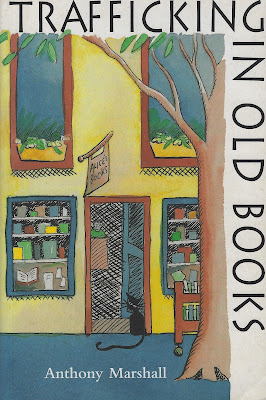
Bookseller and writer Anthony Marshall where art thou, kindred spirit?  I recently discovered your two books by chance in an Austin, Texas used bookstore – Trafficking in Old Books (1998) and Fossicking in Old Books (2004), far from their place of publication in Australia.  There may be copies in abundance in Australia, but they are pretty scarce here—my excuse for overlooking them these many years.  And what an oversight!  Your adventures running an antiquarian / used bookstore in Melbourne and ancillary essays are among the damndest, bestest, funniest biblio-writings I’ve encountered.  Your prose enlightens and surprises: creative skills meeting a worthy subject.  I must simply salute you.
            But I’m just late to the party.  Some sleuthing revealed you received accolades upon publication (and just as importantly, brisk sales) primarily in Australia and the UK, but also a foray into the US where you did a few books signings.  Both books sold in the thousands of copies, not an easy achievement.  (You record a sold-out print run of 5,000 copies for the self-published Trafficking in Old Books.)  You even had a fan base and book signings in Tasmania!  Admittedly, that was much closer to your bookshop in Melbourne than it would be to someone in America, but it sure sounds exotic and alluring as recorded in your delightful Fossicking essay, “Et in Tasmania Ego.”

Friday, February 4, 2022

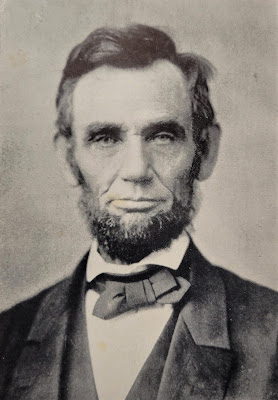
Camaraderie and Competition: The Big Five of Abraham Lincoln Collectors


A recent, unsuccessful bid on a group of Lincoln biblio-books from the collection of Louise Taper leads me here.  That, and a rediscovery last week among a group of books I acquired shortly before moving my library three years ago.  Both instances germinated an idea into an essay – the early collecting of printed material on the Great Emancipator.
            Works by and about Abraham Lincoln, called broadly “Lincolniana,” has been avidly sought by collectors since the Civil War.  Lincoln’s life from homespun roots to statesman to martyr has drawn interest from every conceivable angle.  Publications abound.  As early as 1910 there were already more than 125 separate biographies published.
            Often when I am doing biblio-research, I’m the first to clear a path (or follow one much overgrown).  I soon discovered this was not the case with Lincoln.  The early collecting of Lincoln has been documented directly by collectors such as Daniel Fish (1848-1924) and Joseph Oakleaf (1858-1930), and in secondary essays, most notably J. L. McCorison’s “The Great Lincoln Collectors and What Came of Them” (1947).
            So, a brief overview is at hand without a lot of hacking through the underbrush.  This will be interwoven with my own story of a terrific find.  The early groundbreakers in collecting Lincoln material included Andrew Boyd and Charles Henry Hart.  Boyd and Hart compiled the first major bibliographic work, Memorial Lincoln Bibliography (1870).  These men and others like William Herndon, Lincoln’s law partner and biographer, laid the foundation for subsequent major collectors to follow.  The next group of enthusiasts, labeled the “Big Five” each built fabulous collections during the 1890s-1920s.  Despite the fierce competition among them, they all interacted as friends and colleagues, each to varying degrees willing to help the others and share new discoveries.

Saturday, January 15, 2022

Every Book Its Story

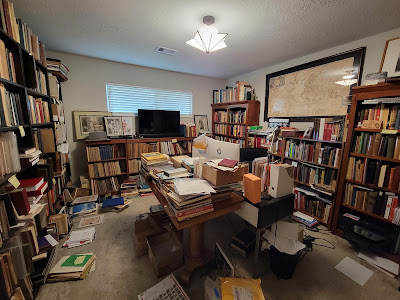
KZ's Office / Cataloging Room.  Wife afraid to enter.

I’m cataloging a few of my recent acquisitions.  They usually arrive one at a time and the backlog is manageable, but this last year has been a deluge.  I’m way behind in bringing order to the chaos.   Stacks of book everywhere in my office: desk, chairs, table.  But with the big exception of pamphlets, I can find what I’m looking for as needed.  My in-house catalogue goes light years beyond an orderly list-keeping: most of the items are association copies and each one merits at least a brief explanation that often expands with research into a mini-essay.  But this is part of the fun for me—story upon story to discover, expound, resuscitate.   I find time when I can to catalog, usually in the evenings and sometimes during the day when work is slow.  It also can be an excuse when yardwork is required or a welcome respite when life takes a stressful turn.  The results of this thirty plus year pursuit of biblio-bliss is a current file of 1,112 pages in 10 point type, and 755,027 words. 
            The bookseller Dorothy Sloan, one of my early mentors, encouraged me to catalog my collection in some form.  Thankfully, I listened, which has not always been my strong suit.  Someday I’ll polish this mighty beast of a document up and formally publish it.  But for now, the catalogue remains open on my computer screen 24/7, always beckoning me to add to it – to feed it new and exciting acquisitions.   And believe me, I do, and I also back the file up to the cloud with religious regularity.
              So, what of it the last couple of weeks?  What books and stories have found the top of the stack to input?  They range from blockbuster associations to more minor items in my biblio-opera.   Come along and catalog with me and get your mind off an upcoming meeting, a thankless task, or an irrational person.

Thursday, November 25, 2021

Kurt Zimmerman: A Talk to the FBS About Bookseller Dorothy Sloan

 I gave a zoom talk recently to the Florida Bibliophile Society about antiquarian bookseller Dorothy Sloan (1943-2021). She was an important mentor in my youth.  The focus is the acquisition of the core of her reference library and portions of her archive.  Jerry Morris, president of the FBS, provides the introduction and the ending presentation.  There were a couple of technical glitches, but all's well that ends well.

Here is the youtube link (talk approx. 37 minutes).


Tuesday, November 9, 2021

William P. Barlow Jr. (1934-2021): Personal Rewards and Universal Benefits


Bill Barlow in his library 2011


William P. Barlow, Jr. (1934-2021) collected books for almost 70 years – an admirable run achieved by few collectors, and rarer still was his ability to recall just about every acquisition going back to the beginning.  A CPA by vocation, Bill was organized, and in case he needed to refresh his memory, he could consult his large, hefty ledger book in which he had written in chronological order each book acquired since the early 1950s.  And there were thousands and thousands of them recorded within.  I saw this ledger first-hand on a memorable visit with my friend Douglas Adams to Bill’s home in Oakland, California in 2011.  News of Bill’s passing on October 21st at age 87 from a heart attack shocked me and stirred many thoughts.

Tuesday, June 8, 2021

Revolution, Redoute, and Why Collect Books?


The stray bullet shattered the hotel window narrowly missing the young American railroad engineer, Will Winterrowd.  He would save it as a souvenir.  It was February 1917 and Winterrowd was watching the plaza below from his hotel room in Petrograd (now called St. Petersburg).  He recalled the chaos he witnessed, “a hooligan with an officer’s sword belted over his overcoat, a rifle in one hand and a revolver in the other; a small boy with a large butcher’s knife, a soldier with an officer’s sword in one hand, without the scabbard, and a bayonet in the other hand; another with a revolver in one hand and a tram-railer cleaner in the other; a student with two rifles and a band of machine-gun bullets around his waist. All were singing, shouting, and repeatedly firing off their weapons into the air.”

Thursday, April 15, 2021

McMurtry, Pass By

Larry McMurtry & Kurt Zimmerman in 2012

Larry McMurtry died recently, and both the writing world and the antiquarian book trade mourn his passing.  McMurtry thought of himself as a bookseller as much as a writer, although that is not how he will generally be remembered.  For he was a good and prolific author of fiction; a natural storyteller that also ventured successfully into history, screenplays, and insightful essays which covered many topics.  I enjoy his essays the most.  But I still a have a tough time forgiving him for killing off Gus McCrae’s pigs at the end of Lonesome Dove.
        McMurtry scouted and sold used and rare books since his college days.  These scouting adventures were loosely drawn upon for example in his novel Cadillac Jack about a rodeo cowboy turned antiques hunter.  McMurtry had a predilection for buying whole book collections rather than straining out the rarities and leaving the rest.  He told me in 2012 he’d purchased the stock of twenty-six used / rare bookstores and over 200 private collections.  So, he dealt mainly in quantities of better used books rather than focusing on rare ones, although he sold plenty of the latter over a long bookselling career.  He would go on to establish used bookstores in Houston, Washington, D.C., and his hometown of Archer City, Texas.  He eventually closed the Houston and Washington, D.C. stores and doubled down on the Archer City location.  Here he filled a number of buildings he owned on the town square with over 300,000 books in all subjects.  He may have had an American vision of Hay-on-Wye in mind.  That didn’t quite happen, but he did attract a steady stream of book hunters to the tiny north Texas town far from big city amenities. 
I made my first book buying pilgrimage to Archer City in 2001.  I arrived on a toasty August day, stopped at the Dairy Queen for an Oreo blizzard, and got situated in my room at the Lonesome Dove Inn.  The Inn was owned by friends of McMurtry.  They were used to having a variety of book hunters come through – in fact, I think book people were their primary guests.  I still have my Lonesome Dove Inn t-shirt.